What's up with those "VEKS EVICT" stickers?
2026 Mar 26
blog.lauramichet.com
Inexplicable graffiti stickers are always everywhere, such as this one I spotted recently in Campbell, California: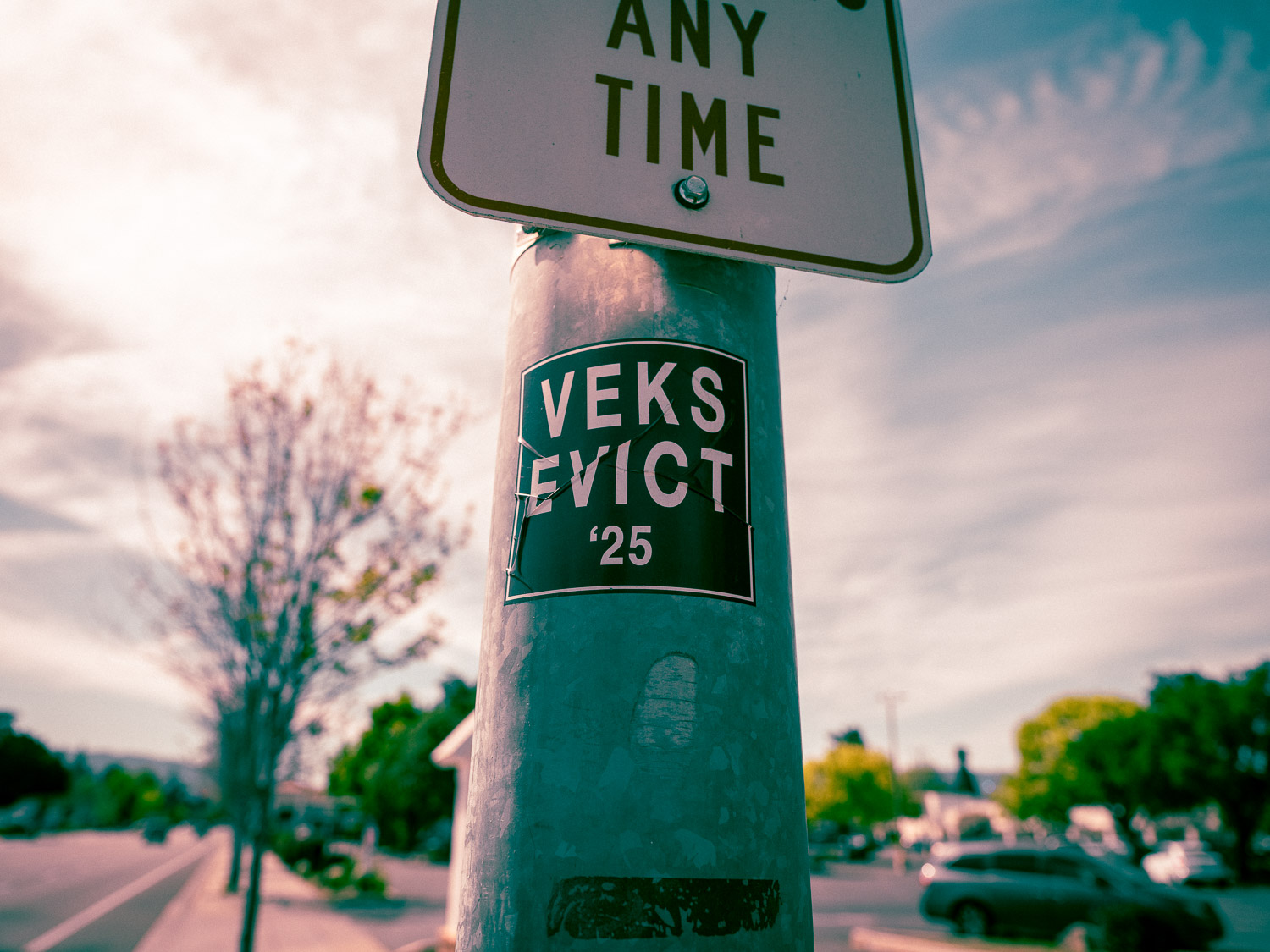 I don't know why I bother searching for deeper meaning, as if I live in Thomas Pynchon's The Crying of Lot 49, yet I keep doing so. Los Angeles video game designer Laura Michet had a similar curiosity October a year ago:
Inexplicable graffiti stickers are always everywhere, such as this one I spotted recently in Campbell, California:
I don't know why I bother searching for deeper meaning, as if I live in Thomas Pynchon's The Crying of Lot 49, yet I keep doing so. Los Angeles video game designer Laura Michet had a similar curiosity October a year ago:
I'm sure that this is a two-person project, since you can google up each of these graffiti writers individually and find traces of them online. I've wondered whether more than two people are putting them up, though - they're incredibly dense, all over the city. Most of the time when I'm riding on a major stroad or artery in the city, I'll see one of these at least once a minute - often more frequently! Apparently, you can find them in Toronto and SF too.
In Mahjong's 'bamboo' suit, each of the tiles depicts a number of bamboo sticks corresponding to the tile's value: e.g. 3 Bamboo shows three sticks of bamboo, 4 Bamboo shows four, and so on. Except 1 Bamboo, which depicts... a bird. Why?
Nobody really knows. But this website proposes a theory, complete with having found very old examples of the 1 Bamboo tile artwork and its evolution from something sometimes resembling a bamboo sprout into a crane or peacock.
So what's the answer? Maybe the Mahjong tile makers just like it that way.